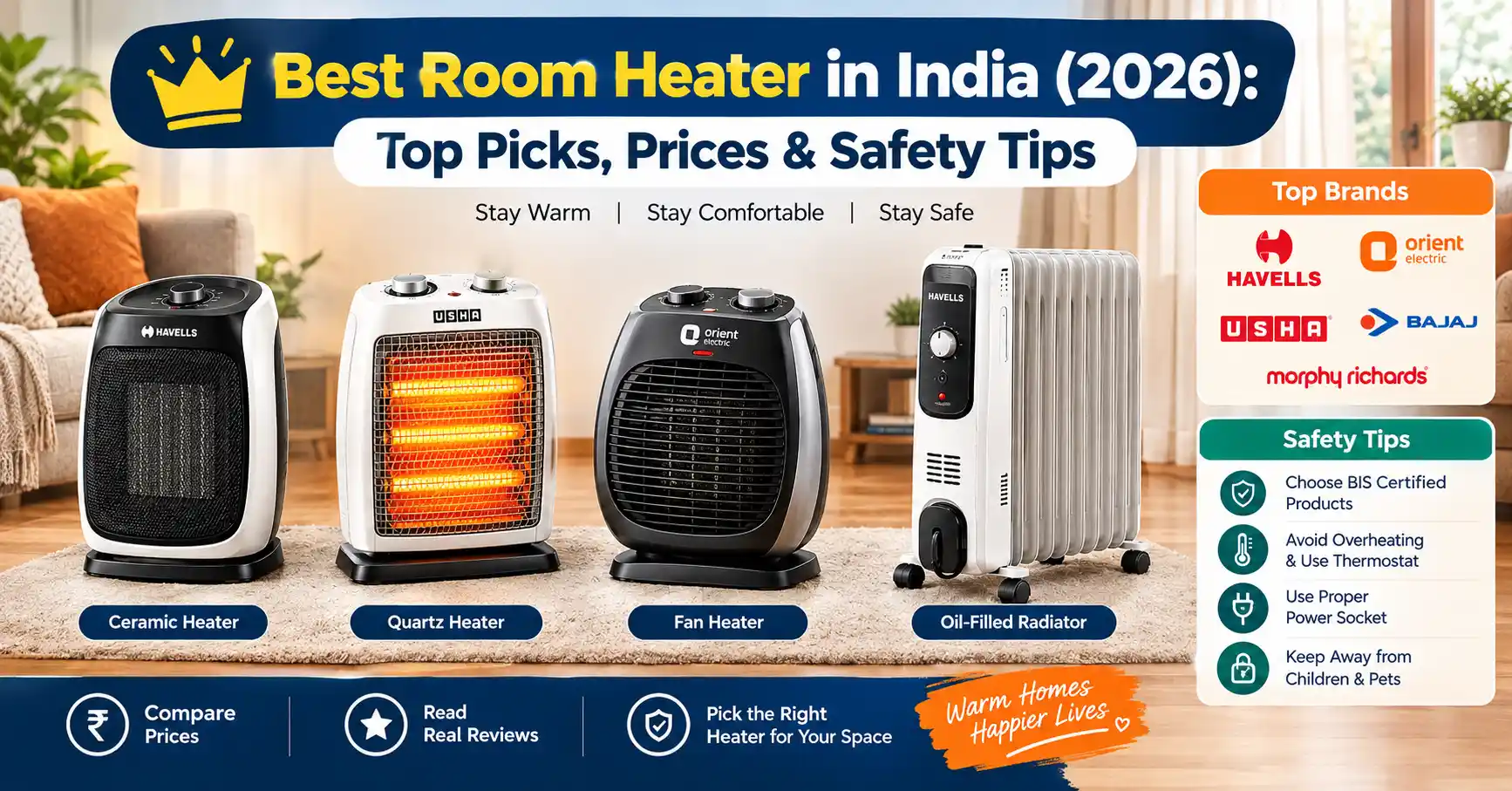
Which Room Heater Is Best for Winter in India?
The best room heater for winter depends on your room size, budget, local climate, and how you plan to use it. Oil-filled radiators (OFRs) provide quiet, steady warmth, fan heaters warm nearby spaces quickly, and quartz heaters deliver direct radiant heat to people sitting in front of them.
Before buying, compare the heater’s wattage, safety features, warranty, and recommended room size. Also check whether your electrical outlet can safely handle its power requirements.
| Heater type | Best suited for | Approximate price range |
|---|---|---|
| Oil-filled radiator (OFR) | Quiet, steady heating | ₹7,000–₹15,000 |
| Fan or blower heater | Quick, affordable warmth | ₹1,000–₹2,500 |
| PTC ceramic heater | Fast heating with ceramic elements | ₹2,200–₹4,500 |
| Quartz or radiant heater | Personal spot heating | ₹900–₹5,000 |
Prices are indicative estimates, not live quotations. They vary by model, wattage, retailer, and seasonal discounts. Verify current prices and specifications before purchasing.
Introduction
Winter temperatures can fall sharply across northern India, while homes in other regions may also become uncomfortable during cold nights. A room heater can help make an indoor space warmer, but choosing the right model requires more than comparing prices.
Some heaters provide fast warmth but produce fan noise. Others take longer to warm up but maintain heat after being switched off. Radiant heaters can warm people directly without needing to heat the entire room.
Your choice should balance heating performance, electricity consumption, comfort, and electrical safety. This guide explains the main types of room heaters, compares their advantages, and shows you how to estimate running costs before buying.
Understanding Room Heaters: What They Are and How They Function?
A room heater is an appliance that uses electricity or another energy source to provide warmth. Electric room heaters commonly work through three heating methods.
Convection heating: A heating element warms the surrounding air. Fan heaters use a fan to circulate this air, helping deliver warmth quickly.
Radiant heating: The appliance emits infrared radiation that warms people and objects directly in front of it. Quartz and other radiant models operate using this specific technique.
Oil-filled radiator heating: Electricity heats a sealed heat-transfer oil inside metal fins. The fins release warmth into the room, mainly through convection and some radiation.
Electric resistance heaters convert electricity into heat. However, their comfort and performance differ because of their design, wattage, controls, and how heat spreads around the room.
Types of Room Heaters Available in India
1. Oil-Filled Radiators (OFRs)
Oil-filled radiators contain sealed heat-transfer oil that circulates heat inside the appliance. The oil is not used as fuel and does not normally need refilling.
Advantages
- Quiet operation when the additional fan is switched off.
- Steady heat after the radiator warms up.
- No exposed glowing heating rods in typical designs.
- Suitable for people who prefer less fan noise.
Limitations
- Usually more expensive than basic fan heaters.
- Take time to warm up.
- Can be heavy and occupy more floor space.
- May have a high maximum power rating.
OFRs are worth considering for bedrooms and living rooms where quiet, steady warmth is important. However, they are not automatically safe to leave running unattended or while sleeping. Follow the manufacturer’s operating instructions.
2. Fan and Blower Heaters
Fan heaters pass air over an electrically heated element and distribute the warm air into the surrounding space.
Advantages
- Often affordable and compact.
- Deliver warmth quickly.
- Commonly offer multiple heat settings.
- Easy to move when the appliance is cool and unplugged.
Limitations
- Fan noise may disturb some users.
- Warm air may not spread evenly throughout a large room.
- Air movement can stir up dust.
- High-wattage models require suitable electrical outlets.
These heaters can be useful for short periods in smaller spaces. Check the wattage and recommended room size rather than assuming that every 2,000W model will heat every room equally well.
3. PTC Ceramic Heaters
PTC stands for positive temperature coefficient. These heaters use ceramic heating elements whose electrical resistance increases as their temperature rises. Many models also include a fan to distribute warm air.
Advantages
- Quick delivery of warm air.
- Compact designs.
- Certain units come equipped with customizable temperature controls and built-in thermostats.
- The ceramic element’s characteristics can help regulate its temperature.
Limitations
- Fan-equipped versions still produce noise.
- Safety and temperature controls vary by model.
- Ceramic construction does not guarantee cleaner air or eliminate fire risks.
- Some models cost more than basic fan heaters.
Consider a ceramic heater if you want fast warmth and prefer its design or controls. Compare the actual safety features and performance instead of relying only on the PTC label.
4. Quartz, Halogen, and Carbon Radiant Heaters
Radiant heaters send warmth directly towards people and objects within their effective range. They can feel warm quickly, even before the room’s overall air temperature changes much.
Advantages
- Often available at low prices.
- Many models use lower wattage settings.
- Provide immediate personal warmth.
- Do not require a fan in many designs.
Limitations
- Heat is concentrated in the direction the appliance faces.
- The rest of the room may remain cool.
- Glowing elements can create bright light and hot surfaces.
- Incorrect placement can create a fire or burn hazard.
These heaters may suit someone sitting at a desk or in a particular seating area. Keep them away from bedding, curtains, clothing, and other combustible materials.
Popular Room Heater Models to Compare
The following brands and product families are starting points for research, not a ranking based on independent hands-on testing. Specifications differ between model numbers, so verify each product before purchasing.
1. Oil-filled radiators: Havells, Morphy Richards, and Bajaj
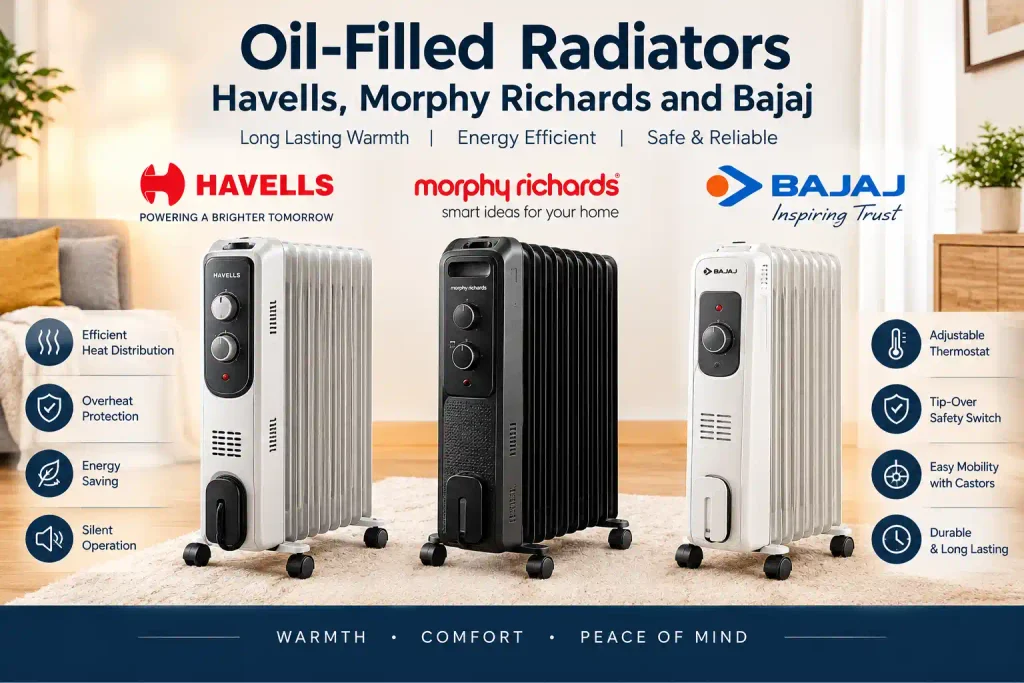
Compare available OFR models from these brands if quiet operation and steady warmth are your priorities.
Check the rated wattage, number of fins, available heat settings, thermostat, tip-over protection, overheat protection, wheels, and warranty. Some models include an auxiliary fan, but its availability and wattage vary.
Do not choose solely by fin count. A higher number of fins does not automatically guarantee that a heater will warm a larger room effectively.
Indicative budget: ₹7,000–₹15,000.
2. Fan heaters: Orpat, Orient Electric, and Bajaj
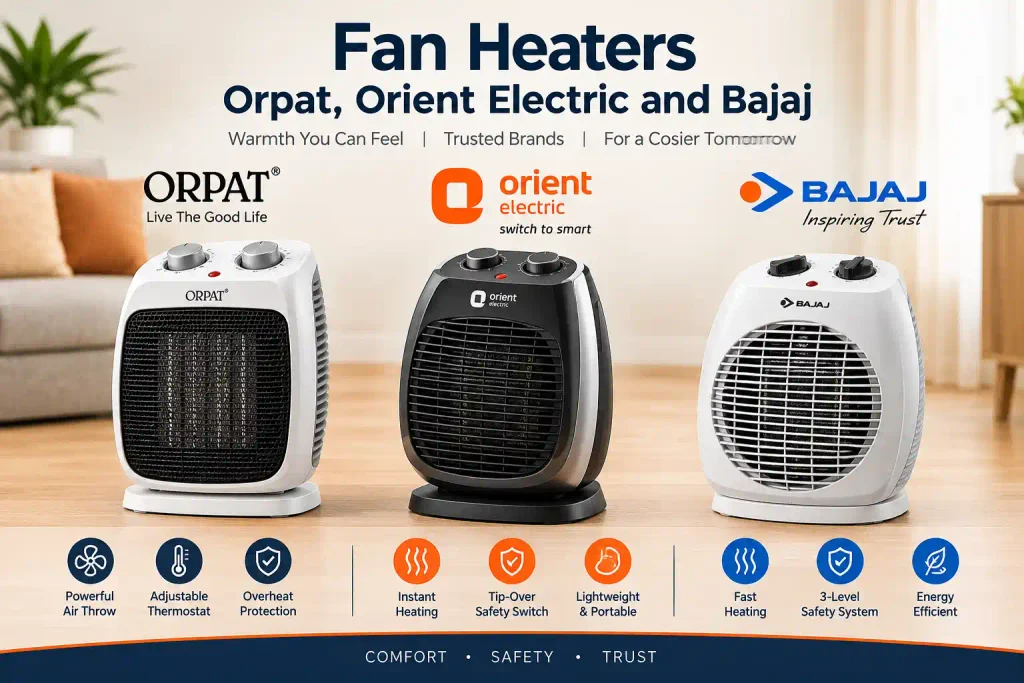
These brands have offered compact heating appliances in different product ranges. Compare the exact model’s heating settings, plug type, thermostat, safety cut-off, and warranty.
A 1,000W setting may be useful when less heat is needed, while a 2,000W setting draws considerably more current. Make sure your electrical installation is suitable for the selected setting.
Indicative budget: ₹1,000–₹2,500.
3. Ceramic heaters: Havells and other established brands
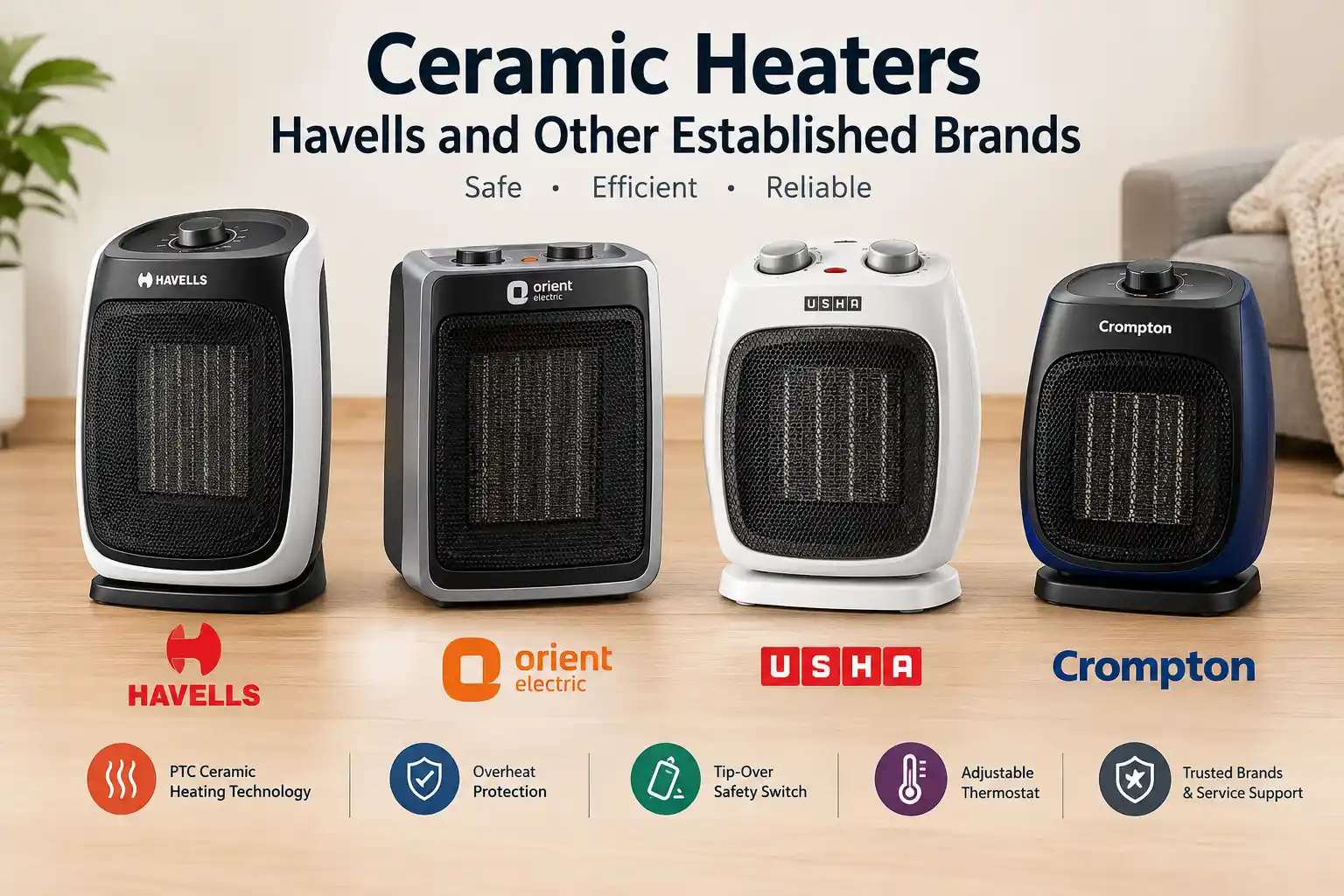
Compare ceramic models based on their heating performance, noise level, controls, and safety protections. Do not assume all ceramic heaters are quiet, dust-free, or safer than every conventional fan heater.
Indicative budget: ₹2,200–₹4,500.
4. Quartz heaters: Usha and Orient Electric
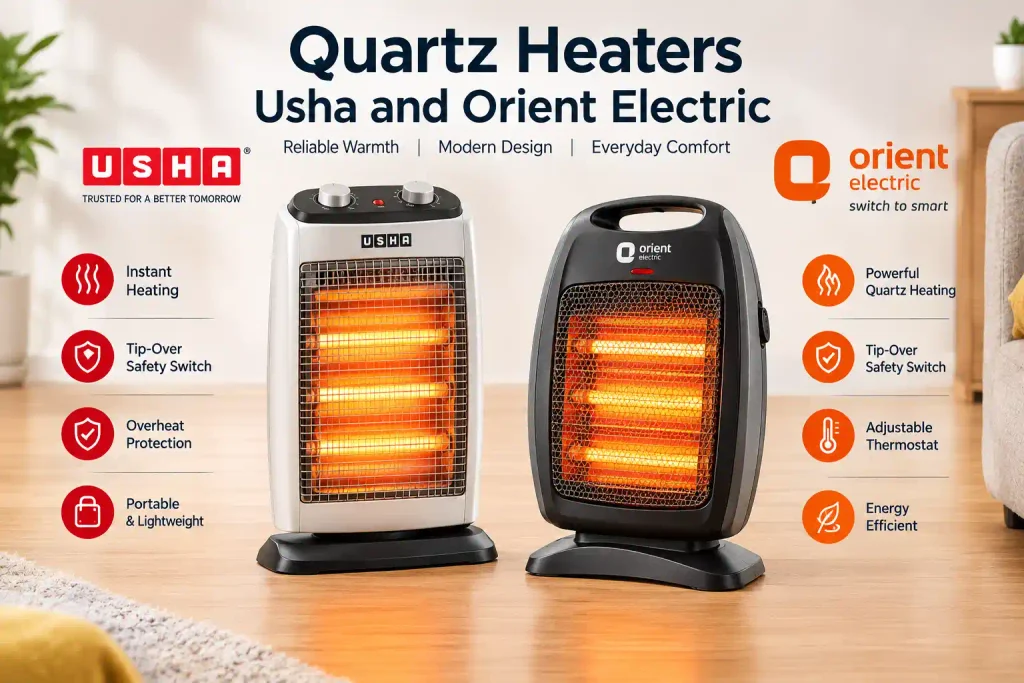
Quartz models can be worth considering for personal spot heating. Check the available wattage settings, protective grille, tip-over switch, and stability of the base.
Indicative budget: ₹900–₹1,800 for some basic models, with other radiant heaters costing more.
Prices and availability change. Add verified product-page links and current prices to this section before publication.
How to Choose the Right Room Heater
1. Consider Your Room Size
Room area is a useful starting point, but it cannot determine the required wattage by itself. Insulation, ceiling height, windows, drafts, outdoor temperature, and the desired indoor temperature also affect heating needs.
| Room Size | What to Consider |
|---|---|
| Up to 100 sq. ft. | Compact fan or radiant heater, depending on use |
| 100–150 sq. ft. | Compare suitable fan heaters and small radiators |
| 150–220 sq. ft. | Check higher-capacity models and manufacturer guidance |
| Larger rooms | Check the manufacturer’s coverage guidance; additional heating may be needed |
These are general comparison categories, not guarantees of heating performance. Always follow the manufacturer’s recommended room size and operating instructions.
2. Compare Wattage and Electricity Use
A higher-wattage heater can deliver more heat per hour, but it also consumes more electricity when operating at full power.
For example, a 2,000W heater draws approximately 2kW while its heating element is operating at full power. A 400W radiant heater draws less power, but it may only warm the person or area directly in front of it.
Choose according to the warmth you need rather than assuming that the lowest-wattage product is always the most economical option.
3. Check the Electrical Outlet
A heater’s power rating determines how much current it draws. At a nominal 230V supply, a 2,000W heater draws approximately 8.7A.
Check the appliance’s plug type and rated current. High-wattage heaters require a compatible, properly installed outlet and circuit. Do not connect them to an unsuitable 6A socket or an ordinary extension board.
If a plug or socket becomes unusually hot, smells burnt, or shows damage, switch the appliance off and have the installation checked by a qualified electrician.
4. Look for Important Safety Features
Useful features may include:
- Overheat protection: Switches the appliance off if it becomes excessively hot.
- Tip-over protection: Cuts power when a compatible heater is knocked over.
- Thermostat: Helps maintain a selected temperature by controlling heating cycles.
- Protective grille: Helps prevent accidental contact with heating elements.
- Stable base: Reduces the risk of the appliance tipping over.
Not every model includes every feature. Verify them in the product manual instead of assuming that a particular heater type automatically provides complete protection.
5. Verify Certification and Warranty
Before buying, check the applicable Bureau of Indian Standards (BIS) requirements for the product category. Where certification is required, verify the marking and licence details using official BIS resources.
Also check the manufacturer’s warranty, service availability, return policy, and the availability of replacement parts. A low price may not be worthwhile if reliable after-sales service is difficult to obtain.
Electricity Consumption and Monthly Running Cost
You can estimate a heater’s electricity consumption using this formula:
Units consumed (kWh) = Wattage × Hours used ÷ 1,000
To estimate the cost, multiply the units consumed by your electricity tariff.
The following examples assume six hours of use each day for 30 days, with electricity priced at ₹7.50 per unit.
| Heater Power | Daily Consumption | Monthly Consumption | Estimated Monthly Cost |
|---|---|---|---|
| 400W | 2.4 units | 72 units | ₹540 |
| 800W | 4.8 units | 144 units | ₹1,080 |
| 1,000W | 6 units | 180 units | ₹1,350 |
| 1,500W | 9 units | 270 units | ₹2,025 |
| 2,000W | 12 units | 360 units | ₹2,700 |
These figures assume the heater draws its full rated power continuously for six hours each day. They are illustrative calculations, not predictions of every household’s bill.
A thermostat-controlled heater may use less electricity if its heating element switches off periodically after reaching the set temperature. Actual savings depend on room conditions, insulation, thermostat settings, and usage. Do not assume a fixed percentage of savings without measured data.
Your final bill may also depend on your local electricity tariff, usage slab, fixed charges, and taxes. Use the per-unit rate on your latest bill for a more accurate estimate.
Room Heaters, Oxygen, Humidity, and Indoor Comfort
Electric resistance heaters do not burn fuel to create heat. Under normal operation, they do not consume room oxygen through combustion or produce combustion-related carbon monoxide.
Gas, kerosene, and coal heaters are different because fuel combustion can produce dangerous pollutants. Never use a charcoal brazier or an unvented fuel-burning heater in an enclosed bedroom.
Electric heaters can still affect comfort. When room temperature rises without a corresponding increase in the amount of water vapour, relative humidity falls. This may make the air feel drier and can contribute to discomfort for some people.
Oil-filled radiators do not inherently maintain indoor humidity, and ceramic heaters do not guarantee cleaner air. Dust, ventilation, and individual sensitivities can affect comfort regardless of heater type.
A bowl of water placed near an electrical heater is not a reliable humidity-control method and introduces a spill risk. If indoor dryness is a concern, consider measuring humidity and using appropriate humidity-control equipment according to its instructions.
Safe Use and Common Problems
The plug or socket becomes hot
Switch off the heater if the plug or socket becomes unusually hot, smells burnt, or shows signs of melting. Do not continue using the appliance until a qualified electrician has checked the outlet and circuit.
Avoid unsuitable extension boards, overloaded sockets, and damaged cables.
A new heater produces a smell
Some appliances may release a temporary odour during initial use. Follow the manufacturer’s instructions for first use.
If the smell resembles burning plastic or comes from the plug, cable, or socket, switch off and unplug the heater if it is safe to do so. Do not use the appliance again until the problem has been assessed.
The heater shuts off unexpectedly
A thermostat may switch the heating element off when the set temperature is reached. Overheat protection may also activate if airflow is restricted.
Turn the heater off, unplug it, and allow it to cool before checking the vents as directed in the manual. Keep it clear of curtains, bedding, clothing, and furniture. Do not bypass a safety switch.
General placement precautions
Place the heater on a stable, level surface and keep it away from water and combustible materials. Never cover it with clothes or use it to dry bedding.
Keep children and pets away from hot surfaces. Follow the manufacturer’s clearance requirements, and do not leave a portable heater operating unattended or while sleeping unless the manufacturer explicitly permits that use and all required precautions are met.
Frequently Asked Questions
1. Which room heater is best for winter in India?
It depends on your needs. An oil-filled radiator may suit people who prefer quiet, steady warmth. Fan heaters provide quick warmth, while radiant heaters are useful for personal spot heating. Compare the exact model’s safety features, power rating, and room-size guidance.
2. Which room heater consumes the least electricity?
A lower-wattage heater generally uses fewer units per hour while operating, but it also provides less heat. Compare the electricity needed to achieve the comfort you want rather than judging efficiency by wattage alone.
3. Is an oil-filled radiator safe for overnight use?
An OFR can provide quiet heat, but its design does not automatically make it safe to leave running unattended or while sleeping. Follow the manufacturer’s instructions and use appropriate precautions.
4. Do electric room heaters burn oxygen?
Electric resistance heaters do not consume oxygen through combustion. However, warming a room can reduce relative humidity, and general indoor ventilation remains important for air quality.
5. Can I run a room heater on a home inverter?
Only if the inverter’s rated output, battery system, and manufacturer’s limits support the heater’s load. Many ordinary home inverters cannot handle a high-wattage heater. Check the actual watt rating rather than relying only on the inverter’s VA figure.
6. Does an oil-filled radiator need an oil refill?
The heat-transfer oil is normally sealed inside the radiator and is not used as fuel. It does not ordinarily need refilling. If the appliance leaks or becomes damaged, stop using it and contact an authorized service provider.
7. Is a hot-and-cold inverter AC more efficient than an electric heater?
A heat-pump AC can deliver more heat per unit of electricity than a conventional resistance heater under suitable operating conditions. Actual performance depends on the model, outdoor temperature, and usage. Consider purchase price, installation, and operating costs before choosing.
Final Verdict
The best room heater in India is the one that matches your room, budget, and heating needs without compromising safety.
- For quiet, steady warmth: Compare suitable oil-filled radiators.
- For quick warmth on a budget: Consider a fan or ceramic heater.
- For personal spot heating: Compare quartz and other radiant heaters.
Before purchasing, verify the exact model, current price, wattage, electrical requirements, safety features, certification where applicable, and warranty. Estimate the running cost using your own electricity tariff, and follow the manufacturer’s instructions for placement and operation
Check This Also
Top Android TVs for Indian Homes: Budget, Mid-Range and Premium Options (2026)